
Reflection for North Balwyn Uniting Church
The Third Sunday of Lent, March 8, 2026
Leviticus 26:3-13
Matthew 6:16-34
‘So do not worry about tomorrow, for tomorrow will bring worries of its own. Today’s trouble is enough for today.’
We have now reached the part of the Sermon on the Mount to which biblical commentators give the title ‘Various Matters’. They suggest that the author of the Gospel according to Matthew has gathered sayings of Jesus given at different times and places and organised them according to key words. Today’s collection is mostly about our attitude to treasure or wealth; the teaching is that we do not need to fret about it or be preoccupied by it, and that we must not become enslaved by it. All that is fine, but Jesus tells his disciples that not only should they sit lightly to wealth, but they also do not need to worry about the necessities of life, because God will feed and clothe them just as God feeds and clothes the birds of the air and the lilies of the field. The language is beautiful, but I feel profoundly uncomfortable standing here in a privileged community within a privileged country and proclaiming that if people ‘strive first for the kingdom of God and his righteousness,’ then they will be fed and clothed. That does not seem to be the way the world works.
The latest UN figures are that about 673 million people, a number twenty-four times the population of Australia, experienced hunger in 2024. Since the ceasefire in Gaza, it is no longer in famine, but 1.6 million people, most of the population of Gaza, are still facing acute food insecurity. In Sudan, so often forgotten by the rest of the world, more than 21 million people currently face acute hunger. Australia does not experience famine in the way that places like Palestine and Sudan do, but the Bureau of Statistics found that 1.3 million Australian households experienced food insecurity at some time in 2023. Households headed by single parents with children were most likely to run out of money for food. We do not like to think of people going hungry in our nation, but throughout my ministry, I have met Australians who, after paying for rent and utilities and transport and school supplies for their children, found that they needed to come to a foodbank or emergency relief program. How would they hear today’s reading?
Jesus talks about the care God takes of the birds of the air and the lilies of the field, but we Australians know that birds and lilies do not escape drought, flood, fire, and cyclone. Life may indeed be more than food, and the body more than clothing, but life is also vulnerable and precarious: human and nonhuman life. In every natural disaster, we see birds and animals, fields and flowers, destroyed. Australia is a continent that can have droughts and flooding rains simultaneously; while I completely agree with Dorothea Mackellar that this just makes us love this opal-hearted country even more, it also means that we are constantly reminded that we cannot take creation’s flourishing for granted.
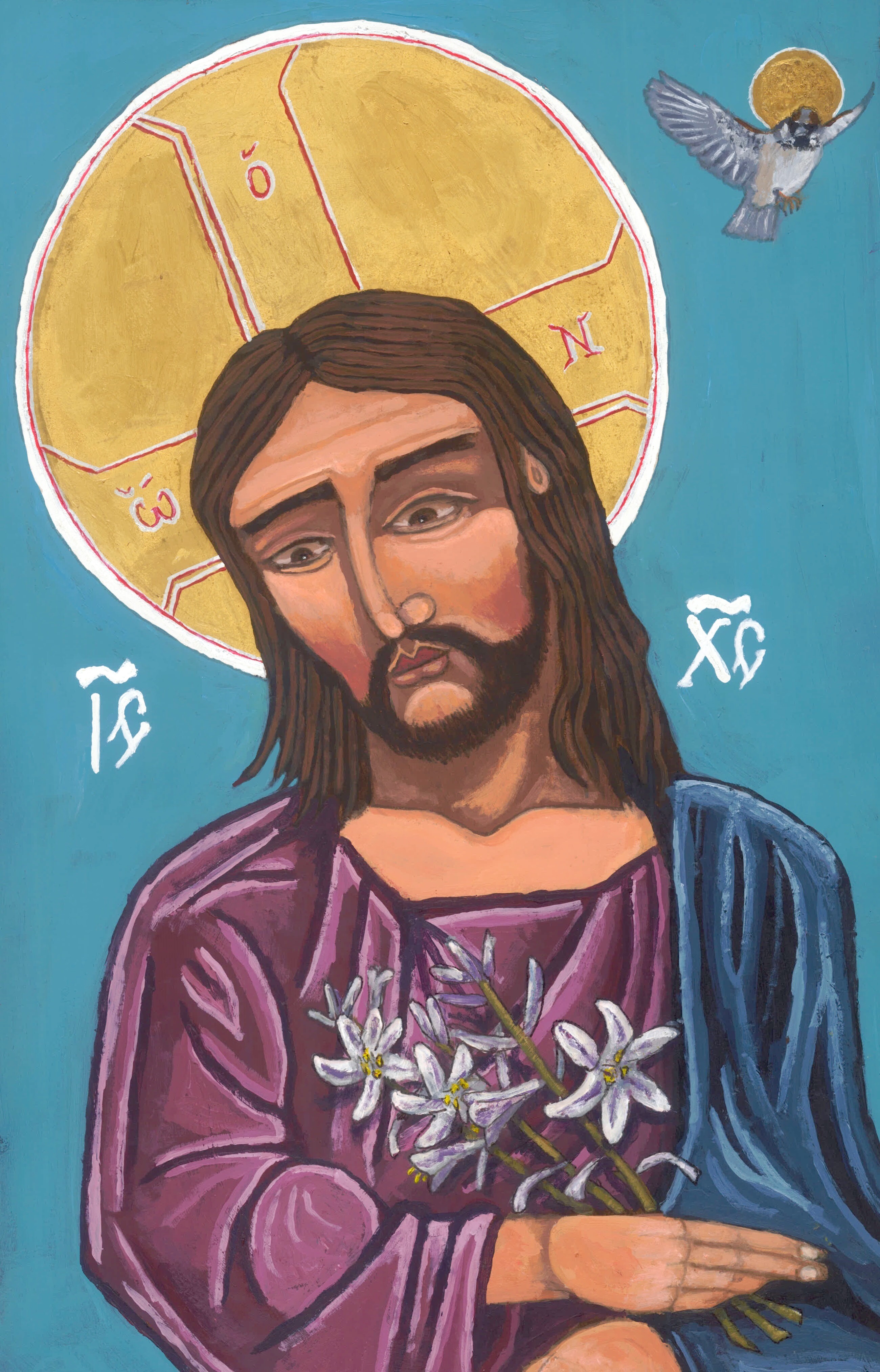
Kelly Latimore, Christ: Consider the Lilies, from Art in the Christian Tradition, a project of the Vanderbilt Divinity Library, Nashville, TN.
Speaking of Dorothea Mackellar reminds us that when Jesus talks about the birds of the air and the lilies of the field, he is speaking in poetry rather than prose. He is telling his disciples that they are even more precious to God than birds and lilies. If God’s continuing care can be seen in the way that birds find food despite neither sowing nor reaping nor gathering into barns, or in the beauty of flowers that neither toil nor spin, then, Jesus says, how much more is God’s care seen in the life of God’s people. Responding to what Brendan Byrne calls the imaginative appeal of this passage, we are reminded that everything we have is a gift from God. Others may pride themselves on being self-made, on having earned their food and clothing by the sweat of their brow; Christians know that our very ability to earn is a gift from God. All that we have comes from God, who does indeed know that we need all these things.
And when God’s provision for humanity seems to go wrong, when people go hungry or lack shelter or clothing or education, we should not blame God. It is not because God has not provided enough for everyone. As I said last week, there is enough food on this planet for every person on this planet, if it is taken, blessed, broken, and given out; if we see our food as a consecrated gift. Those 673 million people I mentioned earlier are hungry because God’s good gifts are not being shared. One of the reasons for this is that those of us with an excess of material goods are frequently too worried about tomorrow to share what we have. It is often fear of the future and the need to protect ourselves financially that prevents us from being as generous as we could be. And so Jesus tells us, ‘Do not worry about tomorrow, for tomorrow will bring worries of its own.’ If humanity can let go of our worry, strive first for the kingdom of God, and share what we have generously without fear that it will leave us short, then we will see God giving ‘all these things’ to those who need them.
The food insecurity currently experienced by hundreds of millions of people is caused not only by greed. Fear of tomorrow can lead people to hoard; it also leads to conflict. What are pre-emptive strikes but tomorrow’s worries creating today’s troubles? Sometimes only the King James version will do; if only more of the world’s leaders believed that ‘sufficient unto the day is the evil thereof.’
I hope I have said enough for you to know that I am not blaming those who do not have enough to eat or drink or wear for their situation. I am most definitely not suggesting that if only they strove first for the kingdom of God and his righteousness, they would receive everything they need. That would be as foolish for us to believe as the millennia-old promise from Leviticus: “I will remove dangerous animals from the land, and no sword shall go through your land. You shall give chase to your enemies, and they shall fall before you by the sword. Five of you shall give chase to a hundred, and a hundred of you shall give chase to ten thousand; your enemies shall fall before you by the sword.” But, very tentatively, with many caveats, I do want to say that in my experience, God provides for us.
John Bodycombe and I used to have arguments about this when I was a student. I have mentioned before the times when, as a penniless university student, I seemed to experience God’s providence; when I would get down to my last few dollars, be unable to both pay utility bills and buy food, and unexpected money would arrive. In our arguments, John would remind me of the times throughout history when God does not provide; his favourite example of what God did not provide was life for people standing in the queues for the gas chambers during World War Two. I absolutely agreed with him – and yet my experience has been that I have received everything that I have ever needed.
Often, what we need is not food, drink, or clothing. Often, what we need is someone caring for us, a sign that the world is not indifferent to us when we are struggling. I believe that God sends us angels, messengers of love, if our eyes are open to them. I have heard from members of this congregation of the times when they have needed to be reminded of the power of love that is at the core of the universe, reminded that the world is full of well-meaning people who are willing to help others, and the love and care they have needed have materialised. One of my greatest joys as a minister is when someone tells me that I have been that angel for them, when God has used me in all my frailty and faultiness to reveal love. I am sure that if you think about it, there have been times when you received the word or the sign or the care that you desperately needed at that moment. I am also sure that there have been times when God has used you to give that word or that sign or that care to someone else. We are not alone in this universe. Our lives are entwined with one another, and it is God who weaves us together.
We are those of little faith, but a little faith is all we need to believe that Julian of Norwich was right when she said, ‘all shall be well, and all shall be well, and all manner of thing shall be well’.[1] Why? Because, as she also said,
Spiritual enlightenment came [to me] with the words, ‘Do you want to know what our Lord meant in all this? Learn it well: love was what he meant. Who showed it to you? Love. What did he show you? Love. Why did he show it? Out of love. Stay with this and you will learn and know about love, but you will never know or learn anything else from it – not ever.’ So I was taught love was what our Lord meant. And I saw with absolute certainty that before God made us he loved us, and that his love never slackened, nor ever will.[2]
So do not worry about tomorrow, because love was what our Lord meant when he spoke to us about the birds of the air and the lilies of the field. God’s love for us has never slackened, and it never will. Amen.
[1] Julian of Norwich, Revelations of Divine Love (London: Penguin Classics, 1998), p. 79.
[2] Julian of Norwich, Revelations of Divine Love, (London: Hodder and Stoughton, 1987), p. 124-5.

 Rev Doc Geek